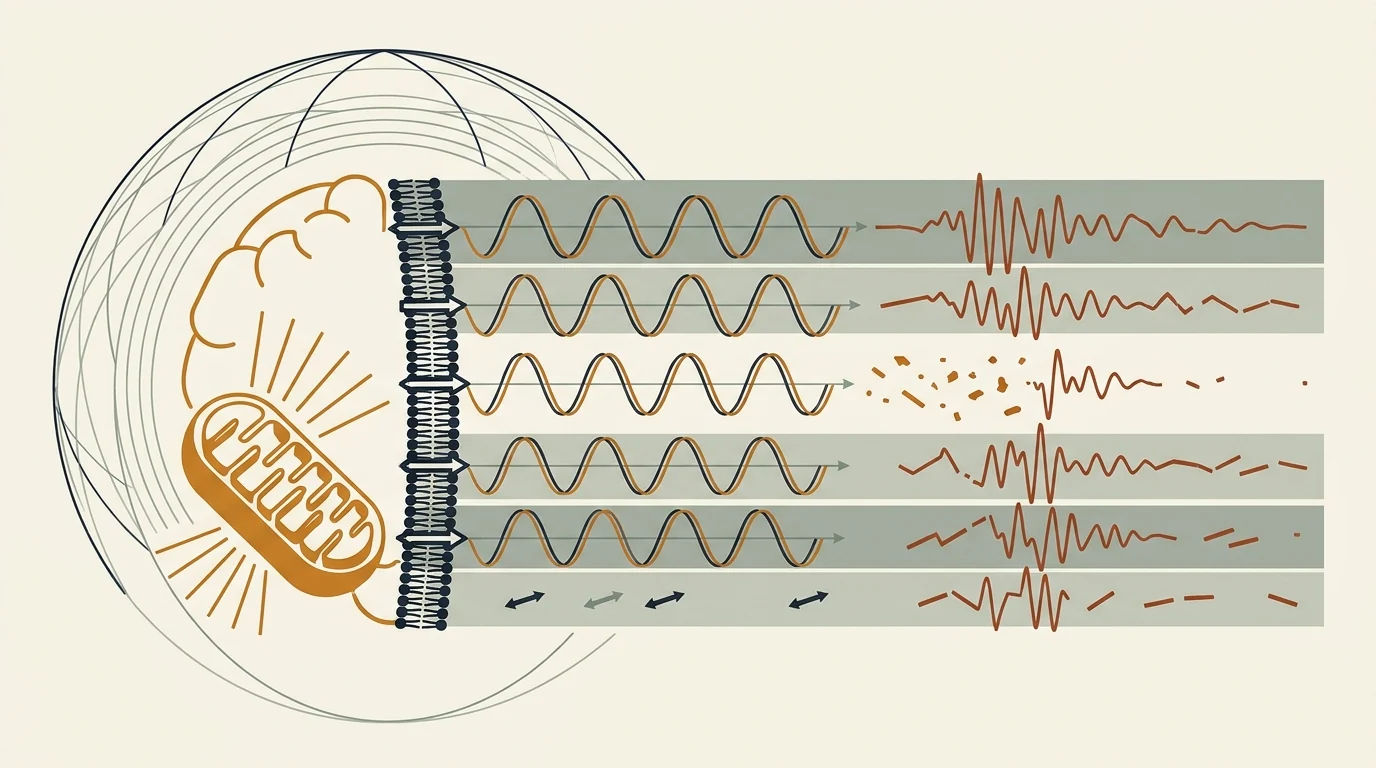
A newly published theoretical framework reveals how systemic failures in neural network synchronization disrupt memory encoding, offering fresh insight into the physical origins of Alzheimer’s disease.
The synchronization crisis of memory
Classical neuroscience has long treated memory formation as a localized affair of individual synapses strengthening in isolation. Yet this reductionist view struggles to account for how a coherent, real-time experience emerges from billions of distributed neural firings across distant cortical regions. The brain must coordinate rapid, sub-second electrical rhythms to bind sights, sounds, and emotions into a single, unified autobiographical trace.
When this large-scale coordination fails, cognitive decline follows long before structural tissue visibly wastes away. Understanding how distributed neural networks lose their cooperative timing remains one of the central challenges in neurodegeneration research, pointing toward a need for physics-based models of brain architecture.
A thermodynamic shift in network theory
To address this gap, researchers publishing in the journal Brain have articulated a comprehensive theoretical framework that repositions memory creation as a macroscopic physical process. Rather than focusing solely on chemical signaling at local synaptic clefts, the model examines how the brain sustains the precise vibrational and electrical states necessary to encode experience.
Building on twentieth-century biophysical insights pioneered by physicist Herbert Fröhlich, who showed how metabolic energy pumps living membranes into coherent dipole oscillations, the new framework suggests that dementia begins when cellular energy deficits silence these long-range rhythmic interactions.
The biophysical mechanics of signal decay
At the cellular scale, healthy neurons require continuous metabolic fuel to maintain the electrical polarization thresholds that allow them to fire in synchrony with neighboring populations. When mitochondrial output drops or cellular stress interferes with membrane stability, the brain loses its capacity to maintain these delicate, zero-dissipation cooperative states.
Without sustained rhythmic coherence across neural networks, incoming sensory patterns fail to lock into persistent, stable memory traces. The new model demonstrates how this energetic collapse cascades upward, transforming microscopic bioenergetic failure into the systemic disconnection characteristic of Alzheimer’s disease and related dementias.
Boundaries of a theoretical architecture
Because this work is a theoretical framework rather than an empirical clinical trial, it does not evaluate patient cohorts, therapeutic interventions, or pharmacological dosages. Its value lies entirely in restructuring how scientists conceptualize the physical underpinnings of cognition.
If future empirical studies confirm how specific bioenergetic failures disrupt large-scale network synchronization, researchers may gain entirely new targets for diagnosing and treating neurodegenerative decline at its physical root.
Key takeaways
- A newly published theoretical framework in the journal Brain reexamines the biophysical mechanisms underlying human memory formation.
- The model proposes that dementia arises from a systemic breakdown in long-range neural network synchronization rather than isolated synaptic failures.
- Cellular energy deficits disrupt the delicate membrane polarization required to sustain coherent electrical rhythms across brain regions.
Source
Reported from Brain model offers new explanation for memory formation and how dementia disrupts it (Medical Xpress Healthy Aging).
Evidence note: The findings are derived from a theoretical framework and do not include empirical clinical trial data, cohort measurements, or tested therapeutic interventions.