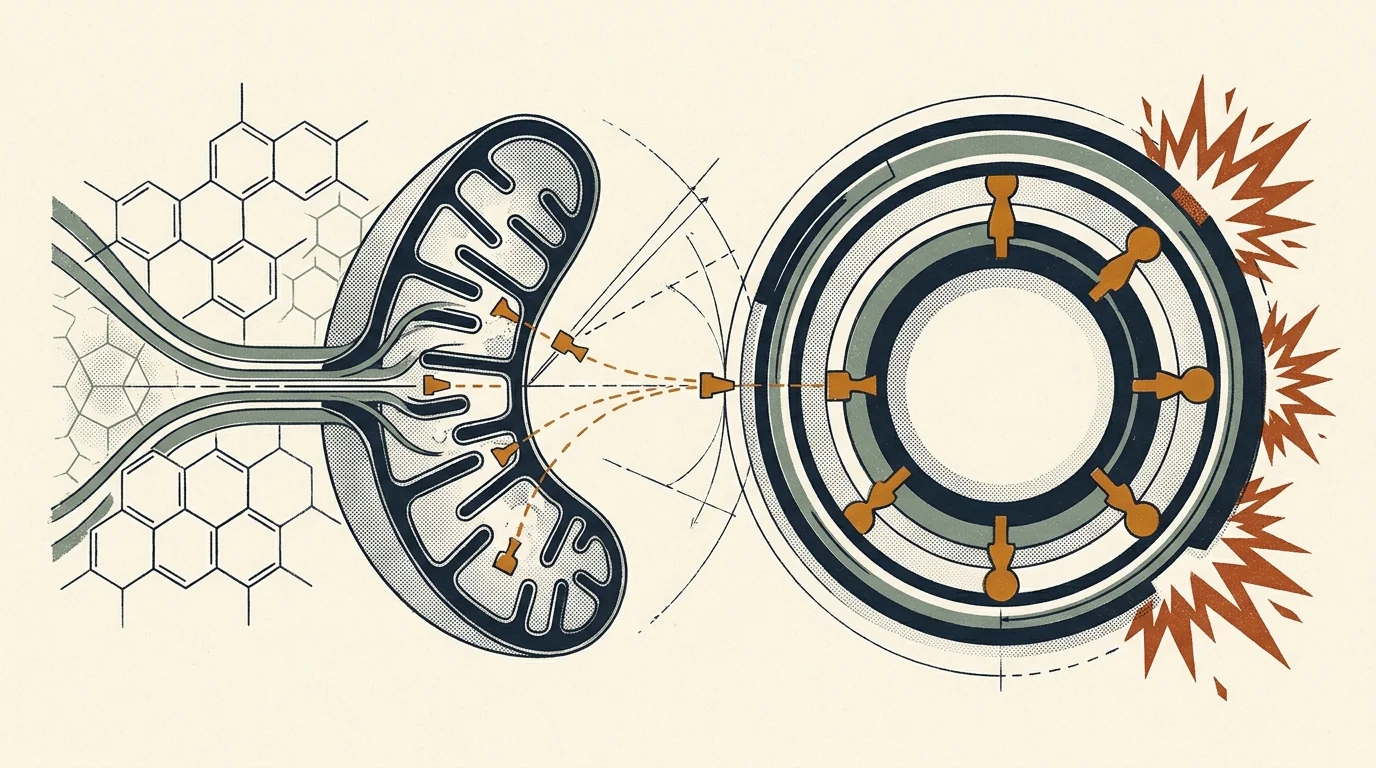
Researchers at USC reveal how specific dietary patterns modulate humanin and SHMOOSE, driving a retrograde signaling cascade that shields vascular and neural tissues from oxidative decay.
Why this matters
Epidemiological data have long shown that traditional dietary patterns rich in unrefined fats, legumes, and botanical polyphenols retard cardiovascular and neurodegenerative decay. However, the precise micro-RNA and peptide messengers translating daily nutrient intake into organelle-level genetic expression have remained elusive. Modern biophysics frames biological aging not as passive structural wear, but as the progressive breakdown of mitochondrial signaling networks and bioenergetic control.
Mitochondria sit at the center of this regulatory network. Far beyond generating ATP via oxidative phosphorylation—a framework established by pioneers like Dr. Otto Warburg—mitochondria maintain a distinct circular genome (mtDNA) that actively coordinates cellular adaptation. When mitochondrial transcription falters, cellular allostatic load increases, exhausting what Dr. Hans Selye identified as adaptation energy and accelerating systemic tissue breakdown.
The discovery that specific nutrient inputs modulate circulating levels of mitochondrial microproteins identifies a direct biochemical conduit between dietary choices and organelle genome expression. This mechanism provides a quantifiable biological metric for precision nutrition, demonstrating how targeted dietary inputs fortify cellular architecture against oxidative stress.
What the study revealed
Investigators at the USC Leonard Davis School of Gerontology, led by Roberto Vicinanza and Pinchas Cohen, quantified plasma microproteins in older adults adhering to varying degrees of the Mediterranean diet. Individuals demonstrating high dietary adherence exhibited significantly elevated circulating concentrations of two mitochondrial-derived peptides (MDPs): humanin and SHMOOSE.
The data revealed distinct nutritional drivers for each peptide. High intake of extra virgin olive oil, wild-caught fish, and legumes correlated directly with elevated humanin concentrations. Conversely, elevated SHMOOSE levels required a combination of high olive oil intake and the marked restriction of refined carbohydrates. Participants displaying higher microprotein concentrations consistently presented lower systemic markers of oxidative stress.
Crucially, the team identified an inverse biochemical relationship between humanin and NADPH oxidase 2 (Nox2)—an enzyme that generates vascular and neuronal reactive oxygen species (ROS). By suppressing Nox2 activity, humanin acts as an endogenous brake on ROS production. This dual-action pathway highlights a robust biochemical mechanism for simultaneous cardiovascular and neurovascular protection.
Mechanisms and interpretation
Mitochondrial microproteins are encoded within short open reading frames (sORFs) embedded inside the mitochondrial genome—genomic regions previously mischaracterized as non-coding DNA. In 2001, Cohen’s laboratory isolated humanin from the 16S rRNA gene of mtDNA, establishing its capacity to neutralize amyloid-beta toxicity. SHMOOSE, encoded within a micro-ORF overlapping the mitochondrial serine tRNA gene, similarly exerts neuroprotective effects by preserving synaptic integrity against protein aggregation.
Biophysically, these microproteins operate as retrograde signals, communicating organelle status to the nuclear genome. Diets rich in monounsaturated fats and intact polyphenols maintain low basal oxidative stress within the mitochondrial matrix. Uninhibited by excessive oxidative damage, the mitochondrial transcription machinery unhinderedly synthesizes humanin and SHMOOSE. Once translated, these peptides cross cellular membranes to inhibit apoptotic cascades, suppress inflammatory signaling, and protect vascular endothelial integrity.
While these observational data are mechanistically compelling, they do not establish direct causality. Elevated humanin and SHMOOSE levels track closely with Mediterranean diet adherence and reduced oxidative markers, but cross-sectional designs cannot confirm whether dietary changes alone trigger microprotein synthesis or if these peptides directly halt human disease progression.
Navigating the findings
These findings support aligning human nutritional inputs with ancestral bioenergetic pathways. Eliminating ultra-processed foods and refined carbohydrates reduces the metabolic substrate required for Nox2-mediated ROS production, preserving the structural integrity of mtDNA. Substituting refined sugars with cold-pressed extra virgin olive oil fosters an intra-cellular environment that supports retrograde peptide transcription.
Integrating dense nutrient sources such as legumes and omega-3 fatty acids provides the essential biochemical precursors needed to sustain mitochondrial density and membrane fluid dynamics. While diagnostic panels tracking microprotein biomarkers remain an emerging clinical tool, prioritizing nutrient-dense, minimally processed foods offers an immediate, actionable strategy to enhance metabolic resilience.
Future interventional trials will clarify whether targeted dietary protocols predictably raise humanin and SHMOOSE levels to lower the incidence of chronic age-related pathology. In the interim, monitoring systemic oxidative markers and maintaining metabolic flexibility represent the most practical clinical strategies for optimizing healthspan.
Three things to remember
- Adherence to a Mediterranean dietary pattern correlates with elevated plasma concentrations of mitochondrial microproteins humanin and SHMOOSE.
- Elevated circulating humanin correlates with suppressed NADPH oxidase 2 (Nox2) activity, curbing the enzymatic generation of vessel-damaging reactive oxygen species.
- Distinct dietary constituents drive separate peptides: extra virgin olive oil and legumes elevate humanin, whereas carbohydrate restriction combined with olive oil elevates SHMOOSE.
Source
This analysis is based on Mediterranean diet may boost tiny proteins that protect the heart and brain from ScienceDaily Healthy Aging. Read the original report for full context.
Health note: This observational cross-sectional study establishes correlation rather than direct causality; the findings do not prove that microprotein elevation directly prevents neurodegenerative or cardiovascular pathology in clinical populations.