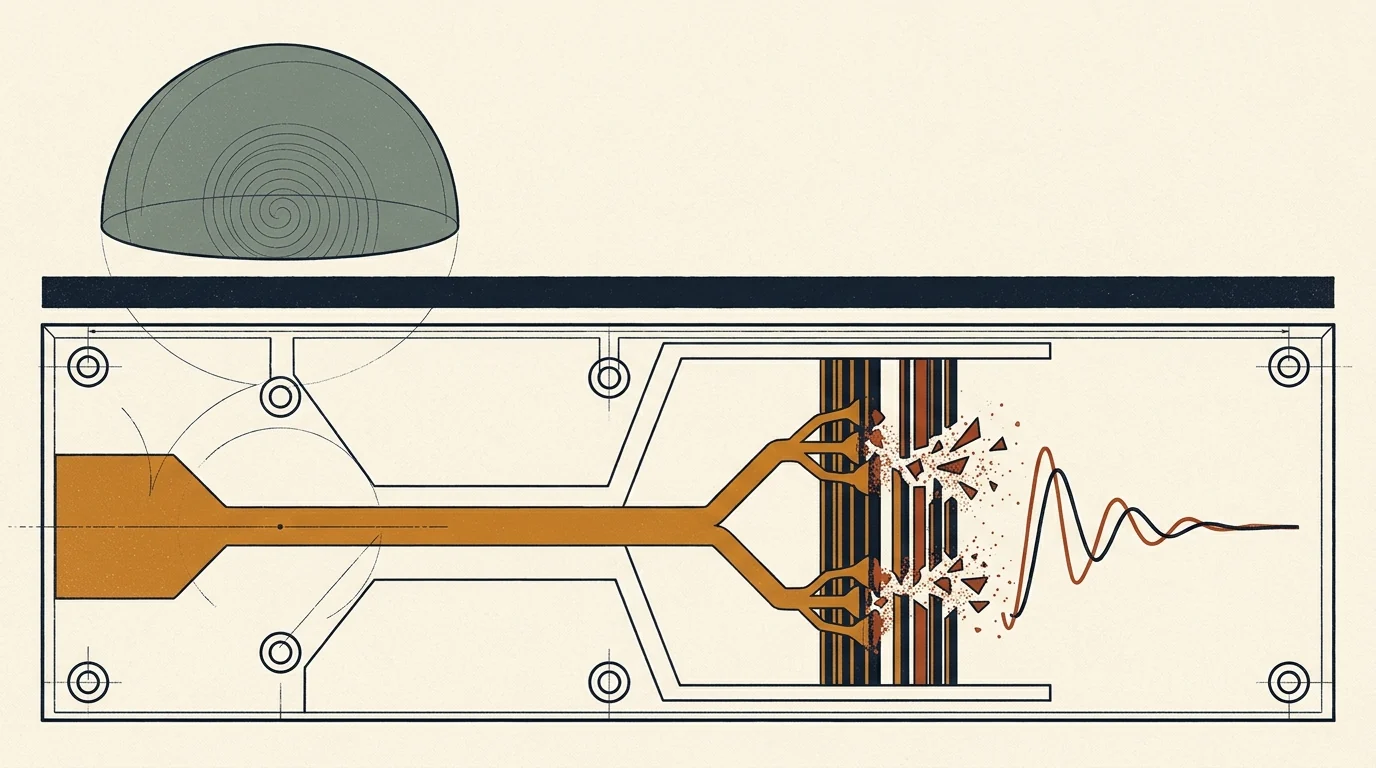
In miniature human-on-a-chip circuits lacking a brain or spinal cord, inherited Alzheimer’s mutations weakened nerve-to-muscle signaling and accelerated muscle fatigue.
Subtle motor changes before memory fades
Clinicians have long noticed that shortened stride, slower gait, and subtle losses of grip or balance often surface years before an Alzheimer’s diagnosis. For decades, neurology treated those physical slips almost entirely as echoes from above: cortical and subcortical brain regions faltered first, and limbs simply reflected the garbled central command.
Yet a 1987 discovery by Konrad Beyreuther and Colin Masters raised a quieter possibility: amyloid precursor protein is produced across peripheral tissues as well as inside the skull. Could Alzheimer’s-linked mutations injure peripheral motor nerves directly at the muscle boundary, even without instructions from a damaged brain?
Answering that question in living patients is notoriously difficult because brain, spinal cord, and peripheral nerves remain wired into one continuous loop. Isolating where motor trouble starts requires stripping away the central nervous system altogether.
Isolating nerve and muscle on a chip
Bioengineers at the University of Central Florida and Hesperos built miniature human-on-a-chip platforms that pair living human skeletal muscle fibers with human motor neurons in a controlled microfluidics chamber. No cortical neurons, brain tissue, or spinal cord circuits were present on the chip, leaving the neuromuscular junction as the sole bridge between electrical nerve impulses and physical muscle contraction.
To test whether Alzheimer’s genetics alone could disturb that peripheral bridge, the researchers grew healthy human muscle cells alongside motor neurons carrying mutations responsible for rare, inherited familial Alzheimer’s disease, then compared their firing and contraction performance against healthy control circuits.
Even in complete isolation from the brain, the mutation-carrying circuits misfired. Motor neurons bearing familial Alzheimer’s variants struggled to drive steady, repeatable muscle contractions, and the paired muscle fibers fatigued markedly faster under repeated stimulation than muscle wired to healthy motor neurons.
Breakdown at the neuromuscular junction
Every skeletal muscle twitch depends on a tight physical relay: electrical action potentials race down a motor neuron’s long axon, trigger calcium entry at the presynaptic terminal, and release packets of neurotransmitter across the microscopic cleft of the neuromuscular junction. Because motor axons stretch farther than almost any other cell projection in the body, they rely heavily on uninterrupted cargo transport and mitochondrial energy delivery at the nerve terminal.
In the chip experiments, familial Alzheimer’s mutations inside the motor neuron alone were enough to destabilize that terminal relay, even though the muscle cells themselves were genetically healthy. Weakened synaptic drive produced erratic contraction amplitude and rapid exhaustion under pacing, showing that peripheral motor neurons can suffer primary functional failure rather than merely relaying upstream cortical decline.
From isolated chips to living patients
Two major boundaries govern how far this result currently reaches. First, the engineered circuits modeled rare early-onset familial Alzheimer’s mutations rather than the far more common sporadic, late-onset disease that accounts for most diagnoses after age 65. Second, observing peripheral synapse failure in a dish does not prove that neuromuscular junctions break down ahead of hippocampal memory circuits in living people.
Still, isolating autonomous peripheral nerve vulnerability opens practical research doors. Peripheral neuromuscular junctions sit outside the blood-brain barrier, making them far easier to sample physiologically and reach pharmacologically than deep cortical tissue. If longitudinal human studies confirm similar endplate signaling defects in living carriers, peripheral motor physiology could serve both as an accessible functional readout and as a testing ground for nerve-protecting drugs.
Key takeaways
- Motor neurons carrying familial Alzheimer’s mutations disrupted healthy human muscle contractions on a lab chip containing no brain or spinal cord tissue.
- Mutation-bearing nerve-to-muscle circuits produced less consistent contractions and fatigued much faster under repeated stimulation than healthy controls.
- The study models rare inherited mutations in vitro and does not yet prove that peripheral nerve changes precede memory loss in sporadic Alzheimer’s.
Source
Reported from Alzheimer’s may have early warning signs outside the brain (ScienceDaily Healthy Aging).
Evidence note: This study used engineered in vitro human-on-a-chip circuits carrying rare familial Alzheimer’s mutations, so its findings cannot yet be generalized to sporadic late-onset Alzheimer’s or clinical diagnosis in living patients.